Why Stars Seem to Twinkle in Moving Air
Why stars seem to twinkle becomes clear when you follow starlight through moving air, and learn why planets usually appear steadier to the eye.
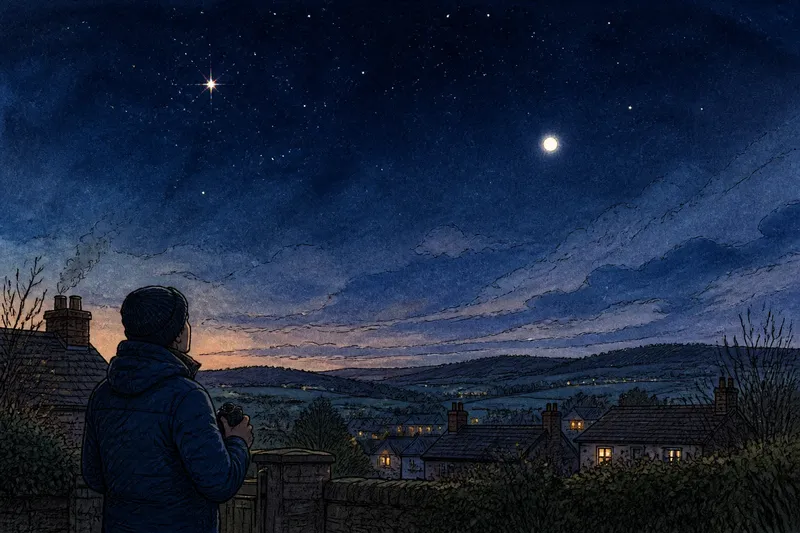
The common mistake is to blame a twinkling star for changing its light. The star is not flickering on and off; moving air above you is bending its light along a restless path. Understanding why stars seem to twinkle makes a familiar point of sky easier to read, and explains why a bright planet often holds a steadier-looking glow.
Starlight crosses layers of moving air
A star is so distant that, to the unaided eye, its light arrives from an almost precise point. Before that light reaches you, it passes through Earth’s atmosphere: a deep column of air whose temperature and density vary from place to place.
Warm air is generally less dense than cooler air. Patches of air at different temperatures mix and shift, making the atmosphere uneven. Since light changes direction slightly as it passes between air of differing density, the incoming beam is continually nudged. Your eye receives those changes as small, rapid variations in the star’s apparent position and brightness.
The effect is called atmospheric scintillation. It is not the star moving across the sky in a visible zigzag, nor is it a change in the star’s actual output that you can track from your garden. It is the atmosphere altering the route and concentration of the light before it reaches your pupil.
A point of light shows every small disturbance
For a distant star, the light reaching your eye comes from a very small apparent point. If shifting air redirects part of that light away from your eye, the star seems to dim; if more arrives, it seems to brighten. A slight shift in direction can also make the point seem to tremble.
Colour can flicker too. Different wavelengths of light bend by slightly different amounts as they pass through air, so a star close to the horizon may flash faintly red, blue or green. The colours are not little lamps switching on around the star. They are brief impressions produced as turbulent air redirects different parts of its light.
Atmospheric movement happens too quickly and irregularly for the eye to follow each bending event. Instead, you perceive a lively shimmer. With a bright star, the effect may be obvious; with a faint one, it may register only as an unsteady point against the darker sky.
Planets spread their light across a small disc
Planets usually look steadier because, although they appear tiny to the unaided eye, they present a small disc rather than an effectively point-like source. Light from different parts of that disc passes through slightly different routes in the atmosphere. One patch may be disturbed while another remains comparatively steady.
Your eye blends those simultaneous impressions. Changes that would make a star’s single point blink are partly averaged across the planet’s apparent disc, so its light often looks calmer. This is a difference in appearance, not immunity: planets still shine through the same moving air and can shimmer when the atmosphere is unsettled.
The comparison is easiest with a bright planet and a bright star at similar heights in the sky. A planet may hold a steadier, more even glow while the star seems to quiver. If both are low, turbulent air near the horizon can disturb them strongly enough that the contrast is less clear.
Low stars have more atmosphere to cross
When a star sits high overhead, its light reaches you through a shorter, more direct column of atmosphere than when it is near the horizon. Near the horizon, the light travels obliquely through more air, passing through more shifting layers. That longer path gives turbulence more opportunity to alter the beam.
This is why a bright star can flash colours and flicker conspicuously as it rises or sets, then appear calmer later in the night. The star itself has not settled down. The viewing path has changed. Buildings, trees and nearby roofs can also create local warm-air currents, so a star seen just above a roof may appear less steady than one at a similar height over open ground.
For a useful comparison, choose a clear view away from chimneys and rooflines, then look at a star and a planet while both are well above the horizon. Give your eyes a moment to rest on each point rather than darting between them. The difference may be subtle, especially if the air is calm.
What changes the twinkle from one night to another?
Does a brighter star twinkle more?
Brightness can make twinkling easier to notice, but it does not by itself tell you how turbulent the air is. A bright star gives the eye a strong point to watch, while a faint one may seem merely hard to see.
Why does a star near the horizon flash colours?
Its light crosses a longer, slanted path through the atmosphere, where changing air can separate and redirect colours slightly. The effect is often most noticeable in bright stars viewed low in the sky.
Do planets ever twinkle?
Yes. A planet can shimmer when it is low or when the air above the observer is especially unsettled. Its small apparent disc tends to soften the fluctuations, but does not remove them.
Can I tell a planet from a star by steadiness alone?
Steadiness is a helpful clue, not a dependable identification method. Planets can twinkle, and stars can look calm; confirm what you are seeing with a sky map or planetarium app.
Use twinkling as a cue, not a verdict
Say you are looking south from an open patch of garden and notice one bright point flashing colour near the rooftops, while another bright object higher up holds a steadier glow. You might suspect that the lower point is a star and the higher one a planet, then check both in a sky map. The expected observable result is a plausible identification to compare with the sky, not proof from flicker alone.
Twinkling also offers a simple way to notice the atmosphere without equipment. Watch how the same star’s appearance changes as it climbs, or compare a point of starlight with a planet on a calm-looking night. These observations turn apparent flicker into information about the path light has travelled.
It is not worth trying to count every flash or assign a colour to each brief shimmer; the variations are too quick and subjective to make that a useful record. Note instead whether the object is low or high, and whether its light looks restless or steady. The phrase why stars seem to twinkle then points to a practical distinction: you are watching the changing air between Earth and the star, not the star switching its light.