The Constellation Line-Drawing Myth
The constellation line-drawing myth can make star patterns easier to read: learn what the connecting lines mean, and how to use them without mistaking them for a map.
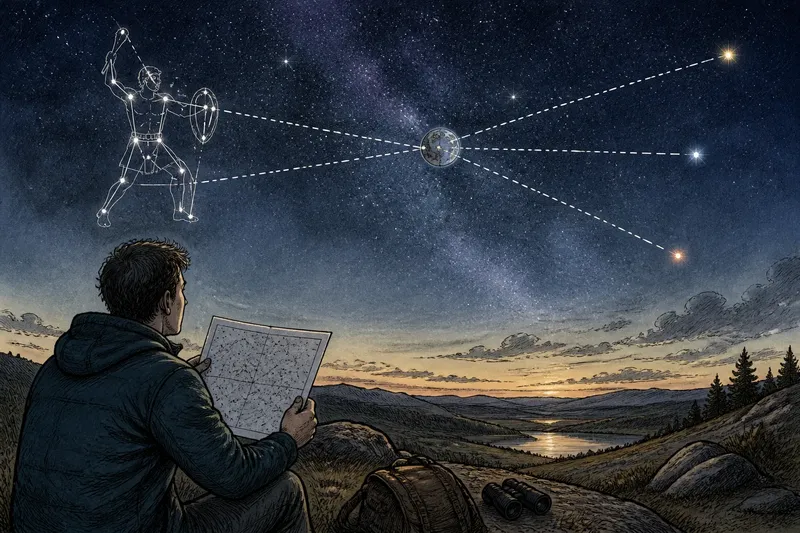
The most common constellation mistake is to treat the familiar stick figure as a picture of stars arranged together in space. The constellation line-drawing myth can make the sky harder to read: a hunter’s belt or a celestial bear appears to promise a tidy shape, while the stars are actually scattered at very different distances from Earth. The lines are a way to remember and recognise a pattern, not marks drawn across the heavens.
Lines connect names, not neighbouring stars
Constellation diagrams join selected stars to make a shape that is easy to recall. The lines have no physical presence in the sky. They do not show strings, tracks, or the edges of a real object.
Nor do they usually connect every star visible within a constellation’s area. Different atlases draw different figures from the same stars. One chart may outline a hunter’s shoulders and legs; another may leave some stars unjoined or use a slightly different route. These choices reflect convention and teaching style, not a change in the stars.
When you look up, the dots of light are the useful part. The strokes in a book are suggestions for how to group them. Let the pattern help your eye find its place, then look beyond its outline to the wider field.
A familiar pattern is a view from Earth
Stars that appear close together on the sky can be separated by vast stretches of space. Their apparent closeness is a matter of viewing angle: from Earth, they sit in nearly the same direction, even though one may be much nearer than another.
Imagine you are standing at the end of a long street, looking at a lamp near you and a bright window far away. They can appear to line up, though they belong to separate places. A constellation offers a much larger version of that perspective effect. Shift the viewpoint far from Earth and the supposed stick figure would no longer look like the chart.
This is why a constellation is best understood as a region of sky and a human-made pattern within it, rather than a single cluster of related stars. Some visible stars do share a physical group or history; the connecting lines alone cannot tell you which ones. That question needs information beyond the shape.
Use the stick figure as a finding aid
For a first look, a simple line diagram is still valuable. It reduces a crowded field to a few memorable points. Start by locating one distinctive feature, such as a short row or a broad angle, then check how the surrounding stars fit the outline.
Try not to demand that the sky reproduce a polished illustration exactly. A chart may exaggerate the spacing, omit faint stars, or join points in a way that looks obvious on paper but less so outdoors. Turn the page so its orientation matches the part of the sky you are facing, and use a nearby bright star or landmark pattern to regain your bearings if the drawing seems unfamiliar.
Say you are trying to recognise Orion from a printed chart. Find the three belt stars first, then use the brighter stars above and below them to orient the rest of the figure. The expected result is a recognisable patch of sky, not a literal outline of a person. If one connecting stroke seems wrong, trust the star positions and recheck the chart’s orientation rather than searching for an invisible line.
What should you expect the lines to tell you?
Are constellation lines official boundaries?
No. They are a visual convention for connecting selected stars, and diagrams differ in how they draw them. The constellation’s mapped region is a separate idea from the stick figure.
Do stars joined in a pattern belong together?
Not necessarily. A line on a chart expresses an apparent pattern from Earth, not a claim that the stars are physically close or connected.
Why do different star charts draw different shapes?
Chart-makers choose different stars and routes to make a figure memorable or clear at a particular scale. Compare the stars themselves before treating a line as essential.
Should beginners learn constellations or individual stars?
Use both, but let a few distinctive stars provide the anchor. A constellation gives you a broad memory aid; recognising individual stars helps you check where you are within it.
What is not worth the effort
There is little value in memorising every line in several competing diagrams before you can recognise the main stars. Choose one clear chart and learn a small number of patterns that help you locate other parts of the sky. The aim is practical recognition, not loyalty to a particular stick figure.
It is also not worth forcing every group of stars into a complete character. Some diagrams suggest animals or people more readily than the sky itself does. If the image refuses to appear, retain the useful geometry: a row, a bend, a pair, or a triangle.
Keep the pattern and the sky in their proper roles
The constellation line-drawing myth fades once you separate the diagram’s job from the stars’ physical arrangement. The diagram helps you remember where to look; it does not explain how far away each star is or whether the stars share an origin. For those questions, consult a reliable star atlas or astronomy reference that gives information about individual stars.
On your next evening outside, use the drawn shape briefly, then look at the gaps between its points and the stars just beyond its edge. That wider view is often a better guide to the sky than completing the picture in your head.