The Moon Before the Telescope: A Month of Watching Its Changes
The Moon before the telescope becomes easier to follow when you record its shape, position and timing across a lunar cycle with a simple routine.
The common mistake in watching the Moon is to treat each sighting as a separate picture. The cost is missing the pattern that made it a dependable calendar long before telescopes. The Moon before the telescope was a recurring presence, and its changing shape and place could be compared from night to night.
You can recover that habit over a month without equipment. A notebook, an open view of the horizon and a few minutes at roughly the same time are enough to notice how a thin crescent becomes a half-disc, rounds out and wanes. The aim is not to recreate ancient astronomy exactly. It is to see what steady observation can tell you before magnification enters the picture.
Begin with a record you can repeat
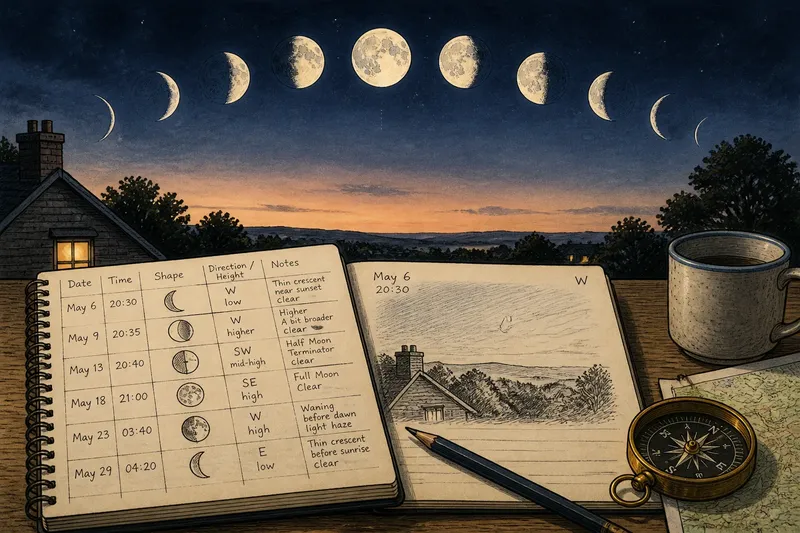
Choose a familiar observing place, such as a garden, balcony or safe public path with an open view. Keep the same general outlook if possible. Mark a fixed landmark in your notes—a roof edge, tree or hill—so the Moon’s apparent position has something to compare against.
Each time you look, record the date, approximate time, visible shape, direction and height above the horizon. Add a brief note about cloud, haze or nearby obstruction, since these can make a thin crescent harder to see. A rough sketch is more useful than an elaborate drawing: show the illuminated side and the boundary between light and shadow.
Do not try to force a sighting every evening. If clouds intervene, leave a blank or note the weather, then resume when the sky clears. A missing observation is part of the record, not a reason to invent what the Moon must have looked like.
Follow the Moon through a month
Use this routine as a flexible sequence rather than a strict timetable. The lunar cycle does not align neatly with a calendar month, and your local horizon and weather shape when each phase is easy to see.
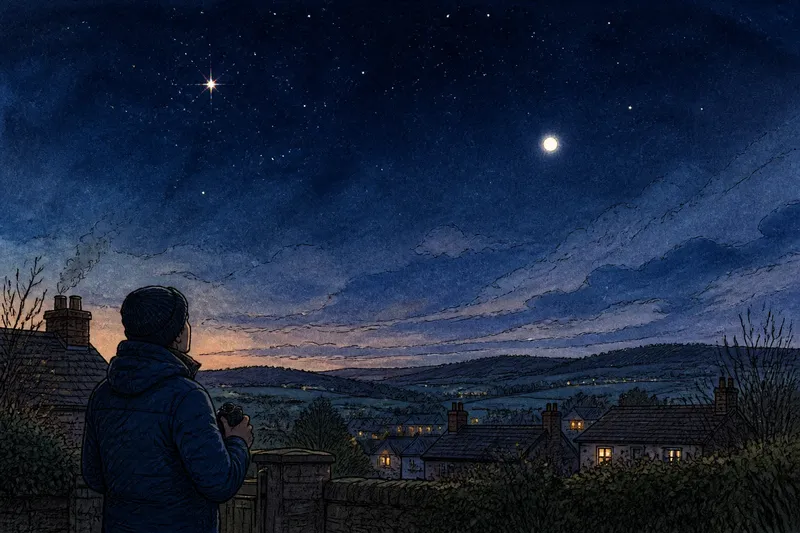
- Look for a narrow crescent. After the Moon has been difficult or absent from the evening sky, check low in the west after sunset. Note how slender the lit portion is and which way its curve faces. A clear horizon matters more than a dark site for this first observation.
- Compare the crescent on following evenings. Look at a similar time and notice whether the Moon appears farther from the sunset glow, higher in the sky, or both. Its illuminated portion grows, but the crescent’s orientation can seem to change with your viewing position and the season.
- Study the boundary near the half-lit phase. The dividing line between lunar day and night is called the terminator. To the naked eye, it reads as a clean curve; the phase is a useful marker because the lit and unlit portions are plainly balanced.
- Watch the Moon rise as it approaches full. The bright disc is easy to recognise, but it can be less revealing of surface relief than the half-lit Moon. Record when it clears your landmark and how its position compares with earlier sightings.
- After full, shift attention to later hours. The waning Moon tends to be more convenient before dawn than in the early evening. If you cannot observe then, note the gap rather than treating the Moon’s absence from the evening sky as a sudden disappearance.
- Look for a thinning morning crescent. Near the end of the cycle, it appears before sunrise and can be low in the east. Keep the observation brief and choose a place where you can see the horizon without looking towards the rising Sun.
Say you begin with a crescent visible above a neighbour’s roof after sunset. You sketch its curve and note the roofline. A few clear evenings later, the Moon sits higher and looks broader against the same landmark. Your entries now show change through comparison, rather than leaving each sighting as an unrelated impression.
Read the pattern people could see
The changing phase offered a dependable rhythm. Before optical instruments, observers could track the Moon’s return to similar appearances and use that recurrence to organise time. The sequence of crescent, half-lit, full and waning forms is visible without specialised tools, making it one of the sky’s most accessible repeating patterns.
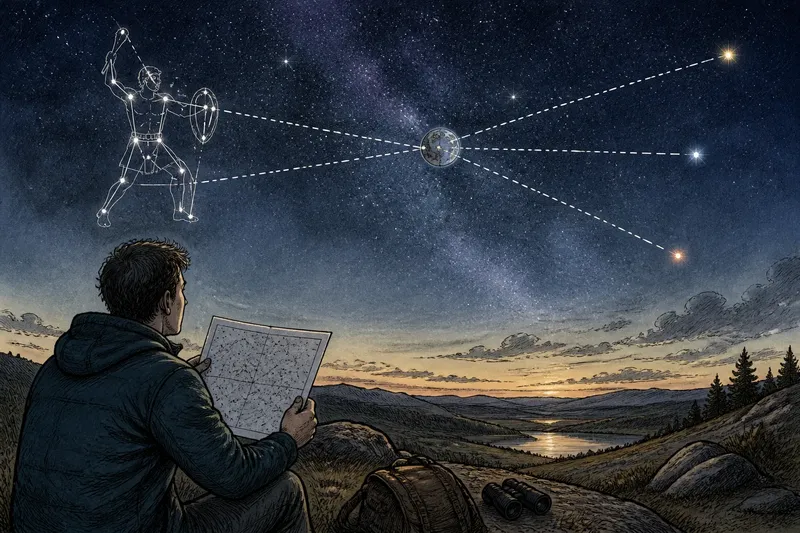
Position added another layer. The Moon does not rise at the same clock time each day, and its place among the stars shifts over its cycle. A careful observer could notice that the Moon returned to a familiar phase after a span of nights while occupying a different part of the sky. That distinction—repeatable phase, changing position—is central to reading the record.
Naked-eye observation also had limits. People could follow the broad shape and motion, but not fine surface details as they later became visible through telescopes. The unaided eye gave a strong account of recurring change, not a close map of craters and mountains. Keeping that boundary in mind helps separate what an observer could see directly from later explanations.
What should you look for as the Moon changes?
Why does the Moon look different from one evening to the next?
As the Moon travels around Earth, we see changing portions of its sunlit half. The Moon itself does not change shape; our viewing angle changes as the positions of the Sun, Earth and Moon shift.
Why does the Moon appear in a different place each time?
The Moon moves along its path through the sky while Earth rotates beneath it. Repeated observations at a similar time make that movement easier to notice against a fixed roofline or distant hill.
Can I follow the cycle without seeing every phase?
Yes. A few observations spaced across the cycle can reveal its broad sequence, and a cloudy interval does not erase the pattern. Record what you actually see, then resume when conditions allow.
Is the full Moon the best time to observe its surface?
The full Moon is easy to spot, but the terminator near the half-lit phases gives the eye a stronger boundary to follow. With the unaided eye, the difference is chiefly in shape and contrast, not fine surface detail.
Keep the record modest and useful
At the end of the cycle, place your sketches in date order and look for three things: how the lit portion changed, how the Moon’s position shifted relative to your landmark, and which observations were missing. This is enough to turn a month of casual looking into a coherent account.
It is not worth assigning exact angles or trying to make every sketch precise. A compass app, elaborate charts and repeated calculations can become distractions when the purpose is to notice a visible pattern. Use a map only if you want to connect your observations to the Moon’s route through the constellations; it is not needed to follow the phases.
For the next cycle, keep the same notebook and add a second line of comparison: whether you saw the Moon in the evening or before dawn. The Moon before the telescope rewards patient return. A few clear entries can show why its changing face served as a recurring marker long before anyone could point an optical instrument at it.